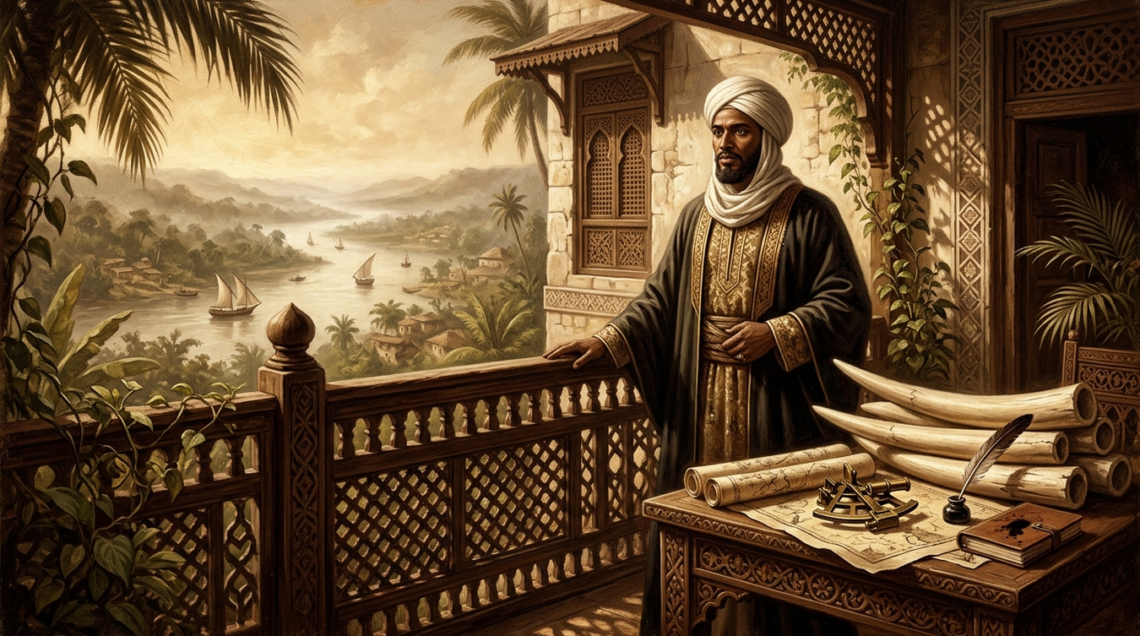
Ruler of the Jungle with Ivory and Chains: The Story of Tippu Tip, Africa’s Most Powerful Trader Who Even European Explorers Bowed To
When people hear about the 19th-century slave trade, most immediately picture American cotton plantations and European ships crossing the Atlantic. Yet at the very moment when Europe and the United States had already outlawed slavery—and British warships were patrolling the oceans to hunt down smugglers—the empire of one single man was just reaching its peak deep in the heart of Central Africa.
His real name was Hamad bin Muhammad, though the whole world knew him by his nickname, Tippu Tip. He was a man of mixed Swahili-Arab descent, a brilliant strategist, a ruthless warrior, and someone who managed to build his own commercial empire inside the impenetrable Congo jungle. He owned ten thousand slaves, controlled the entire ivory trade, appointed local chiefs, and without his blessing, not a single famous European explorer could take a step in the African interior.
How a Nickname Was Born from the Sound of Gunfire
Hamad bin Muhammad was born around 1837 on Zanzibar, an island that served as the main trading hub of East Africa under the rule of the Omani Sultan. His father was a wealthy Swahili-Arab merchant, and his mother came from a prominent Zanzibari family. Young Hamad grew up surrounded by harbor warehouses packed with elephant tusks, cloves, gunpowder, and human misery.
At just eighteen years old, he set out on his first trading expedition into the interior. It was during these campaigns that he earned his famous nickname, Tippu Tip (originally Tippu Tib). According to historical accounts, it came from the sound made by the modern firearms of his soldiers—„tip-tip“—when they fired into the air or at their enemies. For local tribes who only knew bows and spears, that sound was a warning of certain defeat.
A Kingdom of Ivory and Blood in the Heart of Congo
Tippu Tip soon realized that the coast was too crowded for big business. So, he pushed far to the west, crossing Lake Tanganyika into the eastern Congo region (today’s Democratic Republic of the Congo), a place no merchant from Zanzibar had ever reached before.
There, he built an unbelievably profitable and brutal system where ivory and slaves were two sides of the same coin:
- Double profit from every raid. His armed caravans, numbering thousands of men with rifles, attacked remote villages at dawn. The elderly and the weak were often killed on the spot, while the rest were bound with heavy wooden forks around their necks and chained together.
- Living carriers of treasure. Captives weren’t just merchandise to be sold—first, they had to work their way to the market. Prisoners carried heavy elephant tusks on their heads for hundreds of miles through dense jungle all the way to the Indian Ocean coast. During these exhausting marches, roughly a third of them died from hunger, disease, and sheer exhaustion.
- Markets in Zanzibar and Arabia. Those who survived the trek to the sea were sold at the markets in Zanzibar. Men ended up on massive clove plantations, while women and young girls were sold as domestic servants or concubines for harems across the Arabian Peninsula and the Persian Gulf.
In eastern Congo, Tippu Tip built his own capital city, Kasongo. He sat at the head of an empire nobody dared to challenge. Local tribal chiefs were either overthrown or forced to pay taxes in ivory and people. By the mid-1890s, he owned seven large plantations and around 10,000 of slaves.
The Man Without Whom European Explorers Wouldn’t Have Survived
The most fascinating part of Tippu Tip’s life is his relationship with Europeans. While the British public back home was celebrating the abolition of slavery and missionaries were calling for an end to the African human trade, in reality, nobody could survive in the African interior without Tippu Tip.
He was the very man who saved the lives—or secured the passage—of the most famous explorers of that era:
- David Livingstone. When the famous Scottish missionary and fierce opponent of slavery got stranded in the African interior without supplies or medicine, it was the slave trader Tippu Tip who gave him food, porters, and safe passage.
- Henry Morton Stanley. When Stanley set off on his legendary expedition across Africa, he ran straight into territory controlled by Tippu Tip. Without Tippu Tip’s soldiers and knowledge of the terrain, Stanley would never have made it through. The two struck a business deal, and Tippu Tip escorted him for hundreds of miles along the Congo River.
- Governor for a Belgian King. In 1887, one of the greatest ironies in colonial history took place. King Leopold II of Belgium—who had turned the Congo into his personal property while telling the world he was bringing Christianity and ending slavery—appointed Tippu Tip as governor of one of the Congo provinces. Simply put, the Europeans needed his power and trade network to get ivory and rubber out of the jungle.
A Quiet Retirement in Zanzibar
By the 1890s, however, things in Africa were changing fast. European powers were carving up the continent for good, and Belgian colonial troops eventually turned against their former Arab allies to take over the entire trade for themselves.
Tippu Tip was far too smart to fight a war he couldn’t win. He pulled out his wealth in time, left the Congo jungle behind, and returned to his native Zanzibar.
There, he bought a grand stone palace and lived as a respected, immensely wealthy man. He wore a snow-white turban, hosted European journalists and travelers, told them stories of his expeditions into the heart of Africa, and even wrote his memoirs in Swahili—leaving behind one of the most valuable historical accounts of 19th-century Africa written through the eyes of an African himself.
He has died of malaria in June 1905 at around sixty-eight years old. He left behind the story of a man who refuses to fit into simple black-and-white boxes: he was a ruthless merchant trading in human lives, yet at the same time a brilliant organizer and politician who managed to keep both native kingdoms and European empires in check for decades.
Sources & Further Reading
- Tippu Tip (Hamad bin Muhammad) – Maisha ya Hamed bin Muhammed el Murjebi yaani Tippu Tip (memoirs originally written in Swahili, translated into English as Autobiography of Tippu Tip)
- Stuart Laing – Tippu Tip: Ivory, Slavery and Discovery in the Scramble for Africa (a detailed modern biography mapping his trading empire and relationships with European explorers)
- Henry Morton Stanley – Through the Dark Continent (contemporary account by the famous explorer about meeting and working with Tippu Tip in the Congo)
- Wikipedia – entry on Tippu Tip (overview of biographical dates, his 1887 appointment as governor in the Congo Free State, and details of his Zanzibar plantations)
P.S. Please excuse any mistakes in my English—I am currently studying the language, and translating and writing these stories is my favorite way to practice and learn. Thank you so much for your understanding!
Článek obsahuje partnerské odkazy – nákupem přes ně podpoříte tvorbu tohoto blogu, vás to nestojí ani korunu navíc.




Mohlo by se vám také líbit
S mečem proti Hitlerovi: Neuvěřitelný příběh Šíleného Jacka, který válčil s lukem a na bojišti hrál na dudy

Prokletí diamantu Hope: Modrá krev, která nosila smrt